

screenshot taken from: https://www.embedded-world.de/de-de
When
Tuesday, 10th March 2026, 9:00am to 6:00pm
Where
NürnbergMesse GmbH, Messezentrum 1, Nuremberg, Germany
Hosting Organization
NürnbergMesse GmbH
Participation Fee
25 EUR
Agenda
Host Intro, Talk 1, Talk 2, Talk 3, Talk 4, Talk 5, Talk 6 //only covering attended talks
Topics Covered
Warm Welcome to the Conference both in German and in English (Host Intro), Comparing Infineon XENSIV 60 GHz CMOS Radar Sensors and Classic Passive Infrared Sensors for Ultra-Low-Power Presence Detection in Battery-Powered IoT (Talk 1), Memory Bandwidth as the Primary Bottleneck in Embodied Artificial Intelligence (Talk 2), Influence of Contact Design on Board-to-Board Connectors in Phoenix Contact Systems (Talk 3), Smart 8-Channel MOSFET Drivers Powering the 48 V Automotive Revolution (Talk 4), The Baya Systems Approach to the Data Movement Barrier and System Densification in Intelligent Computing (Talk 5), Low-Power AI Engineering with an Ultra-Low-Power Subconscious Mode at Ambient Scientific (Talk 6)
I’ve learned something today
- Token generation is expected to grow by around 120 times, while datacenter power is projected to increase by only about 2 times, creating an efficiency gap of roughly 60 times, often referred to as the power wall. Addressing this challenge requires a journey toward system densification, meaning a much higher concentration of compute and communication to significantly improve tokens per watt.
- Infineon Technologies provides several reference algorithms together with example code to support the development of presence-sensing applications. These resources help developers quickly implement and evaluate radar-based sensing functions in their systems.
- Memory bandwidth is becoming the primary bottleneck in artificial intelligence as the rapid growth of large models far outpaces improvements in data movement between memory and processors, creating a memory wall where powerful GPUs often wait idle for data. This challenge is expected to grow even further with the rise of embodied AI, which requires continuous real-time processing of large volumes of sensor and environment data.
- Insertion loss describes the reduction of signal power as it propagates through an electrical contact or connector system. The commonly referenced −3 dB point corresponds to 50% of the signal power reaching the receiver and is often used as a reference bandwidth indicator in literature. In high-speed contact systems, minimizing insertion loss through optimized contact design is essential to maintain signal integrity and support higher data rates.
- Current computing solutions often require tradeoffs between power, performance, and chip area, making it difficult to optimize all three simultaneously. One common approach to mitigate this constraint is duty cycling, where systems alternate between active and low-power states instead of operating continuously. By activating components only when needed, duty cycling helps reduce overall power consumption while maintaining acceptable system performance.
- Information is Beautiful is a project founded by David McCandless that focuses on transforming complex data, information, and knowledge into clear and visually engaging graphics. Its goal is to help people better understand the world through fact-based data visualizations and infographics.
- Leaving Nürnberg Messe through Entrance Ost, you can walk to Nürnberg Main Train Station in roughly one hour:
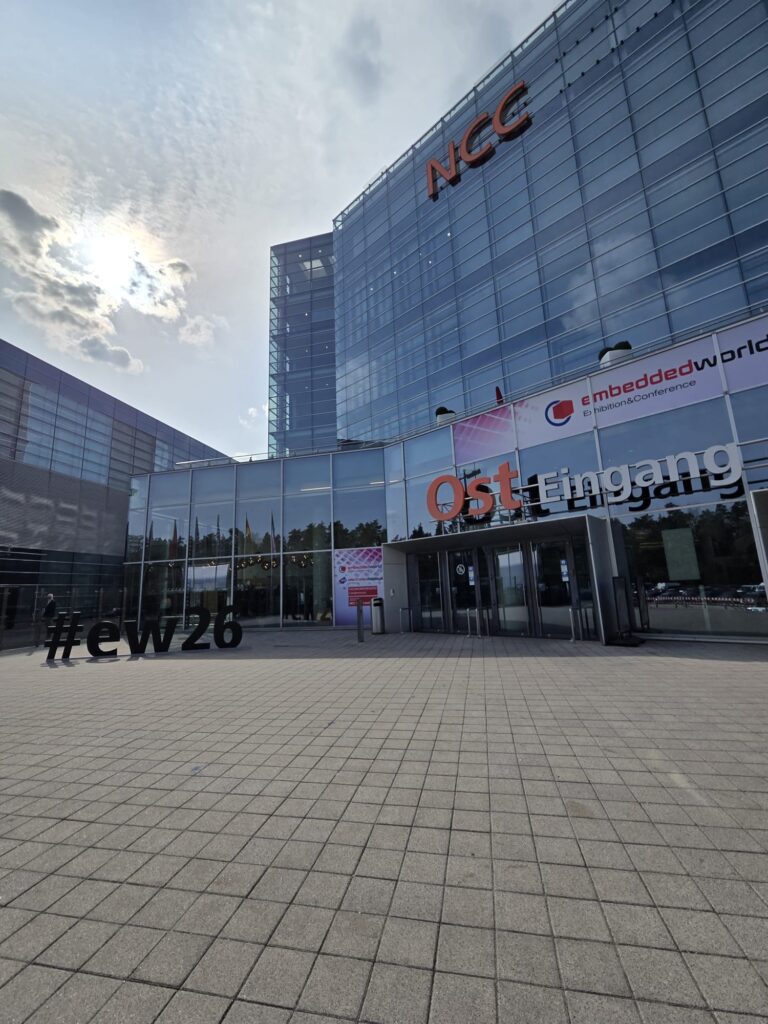
picture taken at venue
Published:
Modified: