
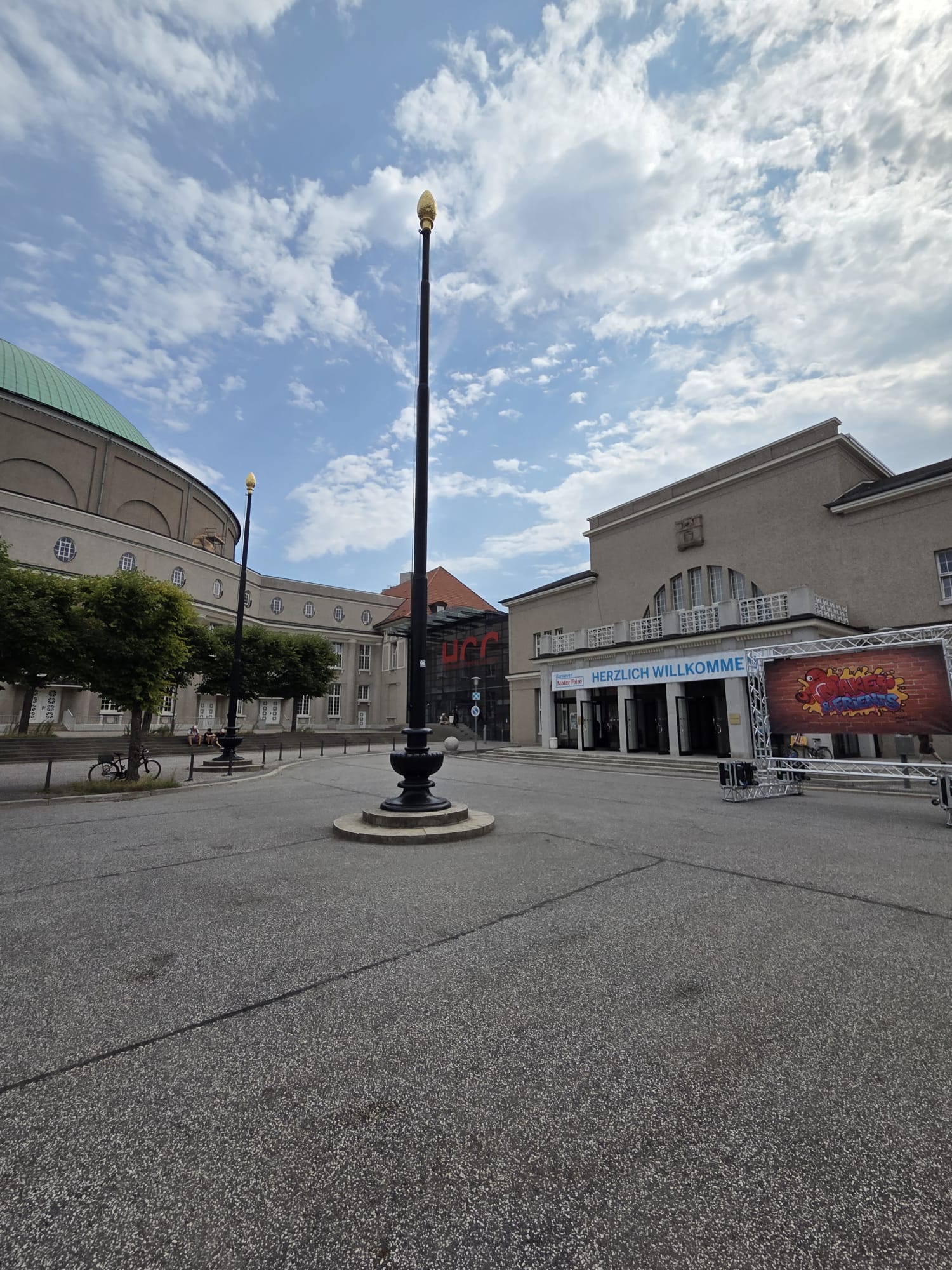
picture taken at venue
When
Saturday, 15th August 2026, 10:00am to 6:00pm
Where
Hannover Congress Centrum, Theodor-Heuss-Platz 1, Hannover, Germany
Hosting Organization
Maker Media GmbH
Participation Fee
24 EUR
Agenda
Talk 1, Talk 2, Talk 3, Talk 4, Talk 5 //only covering attended talks
Topics Covered
FutureForge Kits for Maker Education at Home (Talk 1), The Distinction Between DIY, Maker and Makerspaces (Talk 2), MINT-Campus as an Independent Digital Learning Platform by a Government-Funded Non-Governmental Organisation (Talk 3), How to Build a Zeppelin and How Not to Build One (Talk 4), Employing GenAI in Your Maker Process (Talk 5)
I’ve learned something today
- A DIYer makes things themselves, often following known methods or instructions. For example, they might build a bookshelf from an online plan. A Maker is more experimental and inventive. They tinker, hack and combine tools in their own way. For example, they might design their own modular shelf, 3D-print the connectors and add lights or sensors.
- Dorothee Bär, Federal Minister and official patron of Maker Faire Hannover 2026, wants Germany to become a high-tech republic. In her vision, that would look like a 365-day Maker Faire.
- Agent skills are small, reusable instructions that give AI coding agents disciplined ways to handle tasks like planning, debugging, testing, architecture and code review. The idea is to keep the human in control while making good engineering practices repeatable across different models and projects. Matt Pocock’s open-source collection, which focuses on practical software engineering workflows rather than “vibe coding,” is available here: https://github.com/mattpocock/skills
- LLMs tend to be yapping a lot and trying to impress you with overengineering, which is why the KISS principle matters more than ever. Keep solutions as simple as possible, because complexity should only be added when it actually solves a real problem. The principle is commonly linked to Lockheed engineer Kelly Johnson, who challenged his team to design aircraft that an average mechanic could repair in the field with only a handful of basic tools. Now imagine LLM-designed systems that nobody can easily understand or repair, yet still shape the lives of millions of people.
- “Man scheitert sich durch die Jahre” (“You fail your way through the years”) captures the individual Maker mindset: progress comes through experimenting, failing and learning by doing. “Wenn man lang genug Leute kennt, dann funktioniert’s” (“If you know people long enough, it works out”) captures the community side: over time, Makers build trust and relationships with people who are willing to share knowledge, tools and support when they need it.
- Public and foundation funding often rewards a strong cost per participant ratio, which puts small towns and villages at a structural disadvantage. Fixed costs like rooms and staff do not shrink with population, so programs that are viable in a city like Braunschweig can look inefficient on paper in rural areas despite being socially valuable.
- Behind an unassuming door and up a few stairs, the Hannover Congress Centrum offered additional space for tech talks at this year’s Maker Faire Hannover:
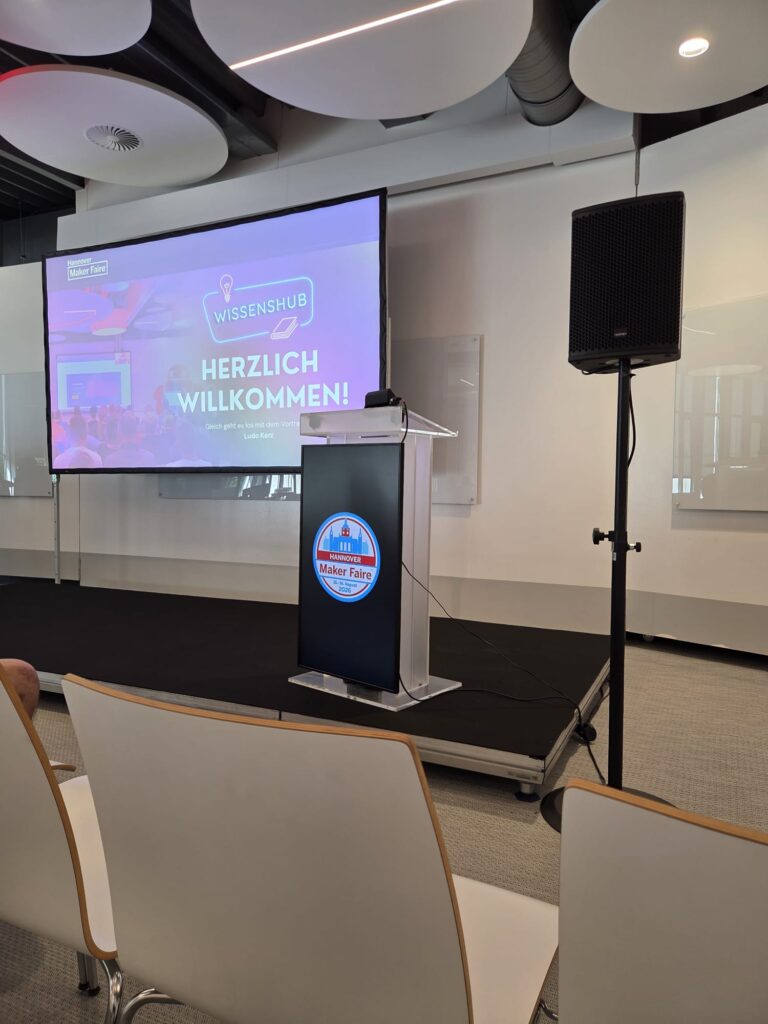
picture taken at venue
Published:
Modified: