
picture taken at venue
When
Monday, 22nd June 2026, 6:50pm to 8:50pm
Where
Red Hat, Friedrich-Ebert-Anlage 49, Frankfurt am Main, Germany
Hosting Organization
Ceph Frankfurt
Participation Fee
Free Entrance
Agenda
Host Intro, Open Discussion, Socializing
Topics Covered
Community-driven Spirit of the Event & Quick Introduction Round among the Attendants (Host Intro), Ceph Lifetime Simulation for Selected Configurations, Fast Erasure Coding, Ceph NVMe-oF Gateway & Other Topics of General Interest (Open Discussion)
I’ve learned something today
- At Cephalocon 2025, Dan van der Ster of CLYSO presented the clyso-nines analyzer and simulator, a Monte Carlo tool for estimating Ceph durability and mean time to data loss across specific cluster configurations (see YouTube). He demonstrated how replication, erasure coding, object size, recovery speed, and PG count can materially change data-loss risk.
- AFR, or Annual Failure Rate, is the estimated percentage of hard drives or SSDs in a population that will fail within one year. Typical values for enterprise storage devices range from about 0.5% to 2%.
- Chorus is CLYSO’s vendor-agnostic platform for migrating, replicating, backing up, and routing object data through S3 and OpenStack Swift APIs with minimal downtime. It is relevant to the Ceph community because Ceph Object Gateway supports both APIs. This allows Chorus to move, synchronize, verify, or route data between Ceph and other compatible storage systems.
- The company Cleversafe developed dispersed object storage technology. It split data into protected slices and distributed them across multiple systems to provide large scale, resilient storage. IBM acquired the company in 2015 to strengthen its cloud object storage business and, as part of the acquisition, gained access to Cleversafe’s patent portfolio of 318 granted US patents.
- The path of least data retrieval means minimizing unnecessary data movement and intermediaries by locating data directly and accessing it through the shortest practical route. Ceph follows this principle through CRUSH-based data placement. This allows clients to calculate where data is stored. Clients then communicate directly with the relevant object storage daemons. This avoids a centralized bottleneck in the data path.
- The Ceph NVMe-oF Gateway closes the integration gap between Ceph storage and platforms that support NVMe/TCP but not native RBD. It is especially useful for VMware, cloud, and SAN environments that want Ceph’s scalability and resilience without changing their existing block-storage workflows.
- From the 11th floor Red Hat has quite the view on the Messe Frankfurt:
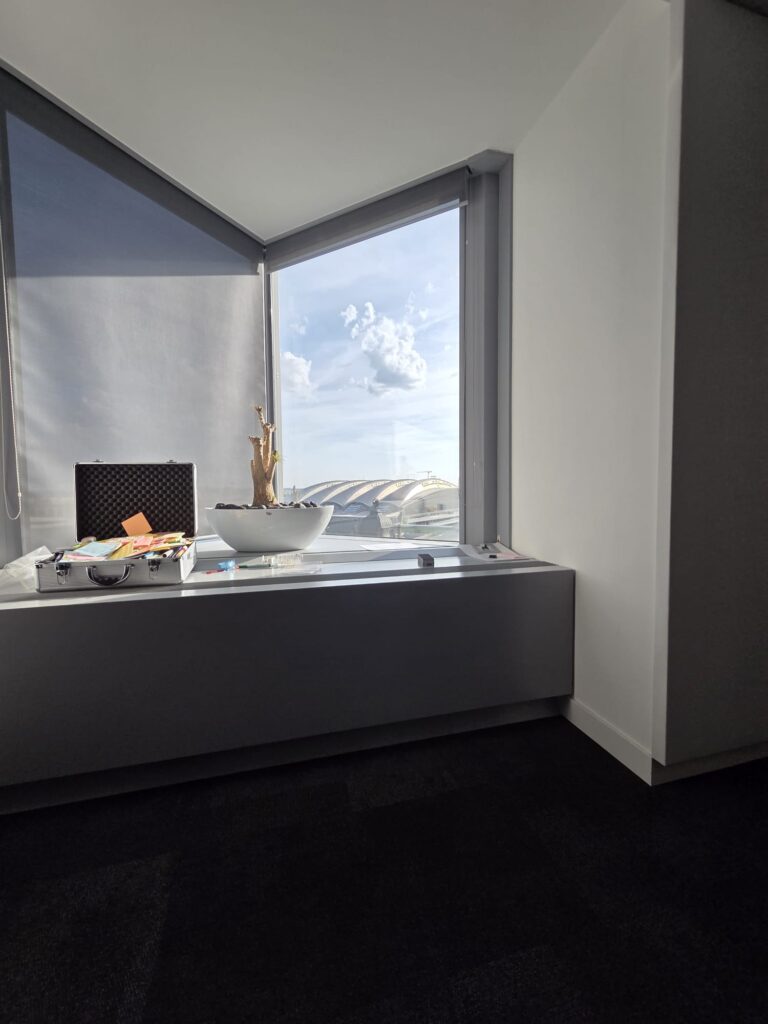
picture taken at venue
Published:
Modified: